
Skip to content
HIKIAgentic Learning Center ES
HIKI · Agentic Learning Center

Learn anything you want.

Write what you want to achieve. We connect it with the knowledge that solves it, tell you what it's good for and design your course applied to your case. When it's ready, you pay and start with your tutor.

We tell you what each piece of knowledge is good for; you learn it in depth and apply it to your case with a tutor who reviews every submission.

Opening soonStudy tailored to you · Featured collection: 5 programs and 33 courses

HIKI route designeronline
Example

You: I want my academy to grow without depending on paid ads.

7:02 PMRead

Agent: What you're after is addressed with growth loops: cycles in which every student who arrives brings the next one.7:03 PM

What it's good for

You'll be able to see where your students come from today, design a cycle in which every student who finishes brings the next one, and measure with your data whether that cycle grows. Paid ads become one of your channels, and you know how much each one brings in.

Your courseGrowth loops applied to your academy
Learning objectives
  • KnowledgeFunnel versus loop; input, action, output and reinvestment; K-factor and cycle time; Collins's flywheel.
  • SkillDraw and measure the loop of your own business.
  • AttitudeDecide with your data rather than last-minute bets.
Syllabus
  • Funnel versus loop
  • Input, action, output and reinvestment
  • K-factor and cycle time
  • Collins's flywheel
Applied to your academy
  1. 1Map your current funnelFunnel with its numbers
  2. 2Your main loopLoop drawn end to end
  3. 3Your K with your dataK-factor and cycle time calculated
  4. 4One-cycle experimentTest run and its decision
Supporting authors
  • Growth Loops are the New Funnels Brian Balfour and Reforge
  • The Cold Start Problem Andrew Chen
  • Turning the Flywheel Jim Collins
Length
About 20 hours
Depth
Apply with judgment
How it's certified
Record of participation with your evidence

Your course is ready

PriceBased on scope and depthCourse · 20 h · Apply with judgment · Custom · AI tutor
How a custom course is designed from what you want to achieve. Illustrative example.
To get started

What you can start studying

Once we open, this is where you'll see what other people are studying most. For now, these are the topics in the Start a Business with AI collection. What people study is gradually organized into new themes and collections.

Featured collection

Start a Business with AI: 5 programs, 33 courses.

The Center's first collection, tied to the book “Your Team of AI Agents”. It shows how we work: each program breaks down into courses that build on one another and closes with a course that brings it all together. It's included in the subscription, and its courses can also be taken on their own.

Map of the programs: each program is a metro line and its courses are the stations. The Your Team of AI Agents program crosses every line and all lines arrive at the live program.02 Start a Business with AIDiscoverDesignValidate03 Strategy and InnovationInnovateCompete and decide04 Finance to Start and Grow05 Growth and Organization01 Your Team of AI Agents · coreLive program
Start a Business with AI collectionHover or focus a station to see the course and what it leaves done.
01Your Team of AI Agents7
  1. Your Team of AI AgentsLeaves done: Your system set up and your first agent working
  2. Your WhatsApp support agentLeaves done: A support agent with a hand-off rule
  3. Your sales follow-up agentLeaves done: A quote and follow-up flow
  4. Your content agentLeaves done: A content bank and a checklist
  5. Your admin agentLeaves done: A report that arrives on its own and payment requests you approve
  6. Your knowledge agentLeaves done: An organized folder and an agent that cites its source
  7. Your agent team working togetherLeaves done: Your team of agents running your business, with its cost dashboard and error log
02Start a Business with AI9
  1. The job your customer hires you forLeaves done: A map of your customer's job
  2. Talk to 10 customers without sellingLeaves done: A script, 10 interviews and your findings
  3. Your value proposition on one pageLeaves done: A value proposition canvas
  4. Your business model on one pageLeaves done: Your Business Model Canvas
  5. Prototype your customer's experienceLeaves done: A tested prototype
  6. Your riskiest assumptionsLeaves done: A Lean Canvas and your assumptions ranked
  7. Your minimum experimentLeaves done: An experiment run, with its decision
  8. What must be true for this to make moneyLeaves done: A plan with assumptions and checkpoints
  9. Validate and launch an offerLeaves done: A tested offer, backed by evidence
03Strategy and Innovation7
  1. What new combination AI opens in your industryLeaves done: A map of new combinations
  2. Where the non-buyers areLeaves done: A map of non-consumption
  3. Your innovation portfolioLeaves done: A map of routine, disruptive, radical and architectural innovation
  4. When your advantage runs outLeaves done: Warning signs and your response
  5. Where the money is made in your industryLeaves done: Five forces and your value chain
  6. Why your business does what it doesLeaves done: Your business's cultural web
  7. Your strategy on one pageLeaves done: Your strategy kernel, with actions and dates
04Finance to Start and Grow7
  1. Your money before you startLeaves done: Your number
  2. Separate business money from yoursLeaves done: Your accounts and your split rule
  3. The decisions that sabotage youLeaves done: Your automatic rules
  4. Your weekly cashLeaves done: A 13-week cash flow
  5. Price without giving away your marginLeaves done: Your costing and a price with its margin
  6. Is this investment worth it?Leaves done: An investment decision
  7. What your business is worthLeaves done: A valuation of your business
05Growth and Organization3
  1. Growth loops: grow your company fasterLeaves done: Your loop drawn, its K and the experiment
  2. Processes that don't depend on youLeaves done: A redesigned process with owners, metrics and agents
  3. Improve your organization's architectureLeaves done: A diagnosis and redesign with the Star Model
Live program: Your business run by agents
See the full collection
The tutor at work

Every submission comes back with its rubric, criterion by criterion.

Your tutor knows the topic you're learning and the case you're applying it to. It reads your submission, quotes the exact part of your work for each criterion and tells you whether it's done or what's missing. When everything is done, it marks the next step on your route.

  • A direct quote from your work in every comment
  • Done or try again, with the reason
  • Your progress is saved in your file
How it works inside
Your HIKI tutoronline
Example

You: Here's my academy's main loop, with its K.

7:02 PMRead
Review of your submission · Growth loops · applied to your academy 2 of 3 criteria done
Your submission

Every student who finishes a course gets a code to give away the first class. Out of every 10 who finish, 4 invite someone, and 1 in 4 of those invited signs up. A full cycle takes about 6 weeks.

Rubric
  1. 1The loop closes: output becomes input Done
    gets a code to give away the first class

    Every student who finishes brings the next one. The cycle is complete.

  2. 2K comes from your data Done
    4 invite someone, and 1 in 4 of those invited signs up

    With your data, K = 0.4 × 0.25 = 0.1 per cycle.

  3. 3Says what you'll move and how you'll measure it Try again
    about 6 weeks

    Choose which lever you'll move first, raising K or shortening the cycle, and the number you'll measure it with.

Agent: You're doing great. Pick your lever, give it a number and send it back.

Next on your route: one-cycle experiment7:03 PM

Illustrative example of a review.
The method

Support steps down pass by pass, until the task is all yours.

Every course goes over the same idea four times. In the first, the house provides everything; in the last, you work on your own business and the tutor only asks and reviews.

  1. 01

    The idea

    The theory in a short video, with its author and a verified public case.

    Who brings the case
    The house
    Role of AI
    None
  2. 02

    Worked case

    The same theory applied step by step to an example business that stays with you across the route.

    Who brings the case
    The house
    Role of AI
    None
  3. 03

    A case from your industry

    A business from your own industry, half built, for you to complete. Your agent checks your work against the rubric.

    Who brings the case
    Your agent, with your profile
    Role of AI
    Checks against the rubric
  4. 04

    Your business

    The full task on your own business. Your agent asks questions, checks each criterion quoting your work and points out your next step.

    Who brings the case
    You
    Role of AI
    Asks, reviews each criterion and marks the route

House supportYour work

The house library

The authors behind every task.

No author is a course: each work comes in so a task turns out well. These are the 42 works cited in the Start a Business with AI collection.

  • Your Team of AI AgentsFelipe López Mora
  • The Mom TestRob Fitzpatrick
  • ContagiousJonah Berger
  • Profit FirstMike Michalowicz
  • Competing Against LuckClayton M. Christensen, Taddy Hall, Karen Dillon and David S. Duncan
  • Demand-Side Sales 101Bob Moesta
  • The Four Steps to the EpiphanySteve Blank
  • Value Proposition DesignAlexander Osterwalder, Yves Pigneur, Gregory Bernarda and Alan Smith
  • Business Model GenerationAlexander Osterwalder and Yves Pigneur
  • Change by DesignTim Brown
  • Running LeanAsh Maurya
  • The Lean StartupEric Ries
  • Discovery-Driven GrowthRita Gunther McGrath and Ian C. MacMillan
  • The Theory of Economic DevelopmentJoseph A. Schumpeter
  • Capitalism, Socialism and DemocracyJoseph A. Schumpeter
  • The Innovator's DilemmaClayton M. Christensen
  • The Innovator's SolutionClayton M. Christensen and Michael E. Raynor
  • You Need an Innovation StrategyGary P. Pisano
  • Creative ConstructionGary P. Pisano
  • The End of Competitive AdvantageRita Gunther McGrath
  • Seeing Around CornersRita Gunther McGrath
  • Competitive StrategyMichael E. Porter
  • Competitive AdvantageMichael E. Porter
  • Exploring StrategyGerry Johnson, Richard Whittington, Patrick Regnér, Duncan Angwin and Kevan Scholes
  • Good Strategy Bad StrategyRichard Rumelt
  • The Psychology of MoneyMorgan Housel
  • Your Money or Your LifeVicki Robin and Joe Dominguez
  • NudgeRichard H. Thaler and Cass R. Sunstein
  • Thinking, Fast and SlowDaniel Kahneman
  • Scaling UpVerne Harnish
  • Corporate FinanceJonathan Berk and Peter DeMarzo
  • Principles of Corporate FinanceRichard A. Brealey, Stewart C. Myers and Franklin Allen
  • Narrative and NumbersAswath Damodaran
  • The Little Book of ValuationAswath Damodaran
  • ValuationTim Koller, Marc Goedhart and David Wessels
  • Growth Loops are the New FunnelsBrian Balfour, Casey Winters, Kevin Kwok and Andrew Chen
  • The Cold Start ProblemAndrew Chen
  • Turning the FlywheelJim Collins
  • Improving PerformanceGeary A. Rummler and Alan P. Brache
  • Operations ManagementRoger G. Schroeder
  • Designing OrganizationsJay R. Galbraith
  • The Structuring of OrganizationsHenry Mintzberg
Your Team of AI Agents
The book · Felipe López Mora

Your Team of AI Agents

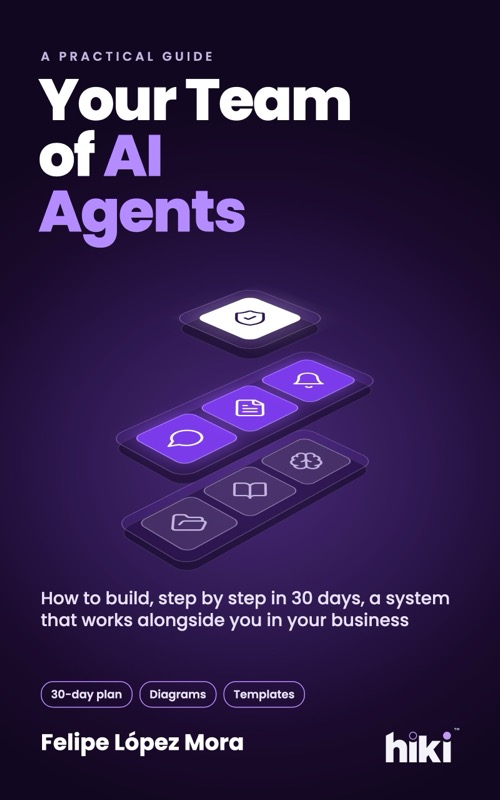
Build a team of AI agents that works alongside you in your business, in 30 days: a folder with what your business knows, a guide file the model reads before it starts, a memory that doesn't get tangled, three agents with a trade, and tasks that run on their own during business hours.

About the book
Live program

Your business run by agents

About 80 hours · Live, in a group, with a teacher

Over the program you redesign your business's whole operation with your team of agents, keep it running week after week and present it to the group, with your strategy and your numbers.

See the program