
Measuring a growth loop: K, cycle time and payback
Three numbers turn a loop on paper into a tool: the K coefficient, cycle time and payback. You learn to work them out with your own data, to find the variable that slows your loop the most, and why retention comes first.
What it solves
With your own numbers you find out whether your customers really bring in customers, how long each round takes and how soon the money you spend to win a customer comes back.
To get started
K = new customers brought in by the cohort / size of the cohort
If 100 March customers brought in 30 new customers, K = 0.3. Andrew Chen writes it as k = i × c (Retention is king, an essay on his site): how many invites each person sends (i) times the share of invites that turn into customers (c).
- K above 1: each cohort brings a bigger one. It's rare, and it rarely lasts.
- K below 1: the loop winds down on its own and needs outside fuel. This is normal.
A K below 1 still pays off: it makes every cohort cheaper. If every 100 customers bring 30, your ads only have to bring 70. For a young company, that's the real win.
Two cautions when you measure it. Only count people the previous cohort brought in: if you add people who came from ads or on their own, K comes out inflated. And to know who brought whom, you need attribution: a link or code per customer, like Bold's or Platzi's, or at least the question "how did you hear about us?" recorded in the same place every time.
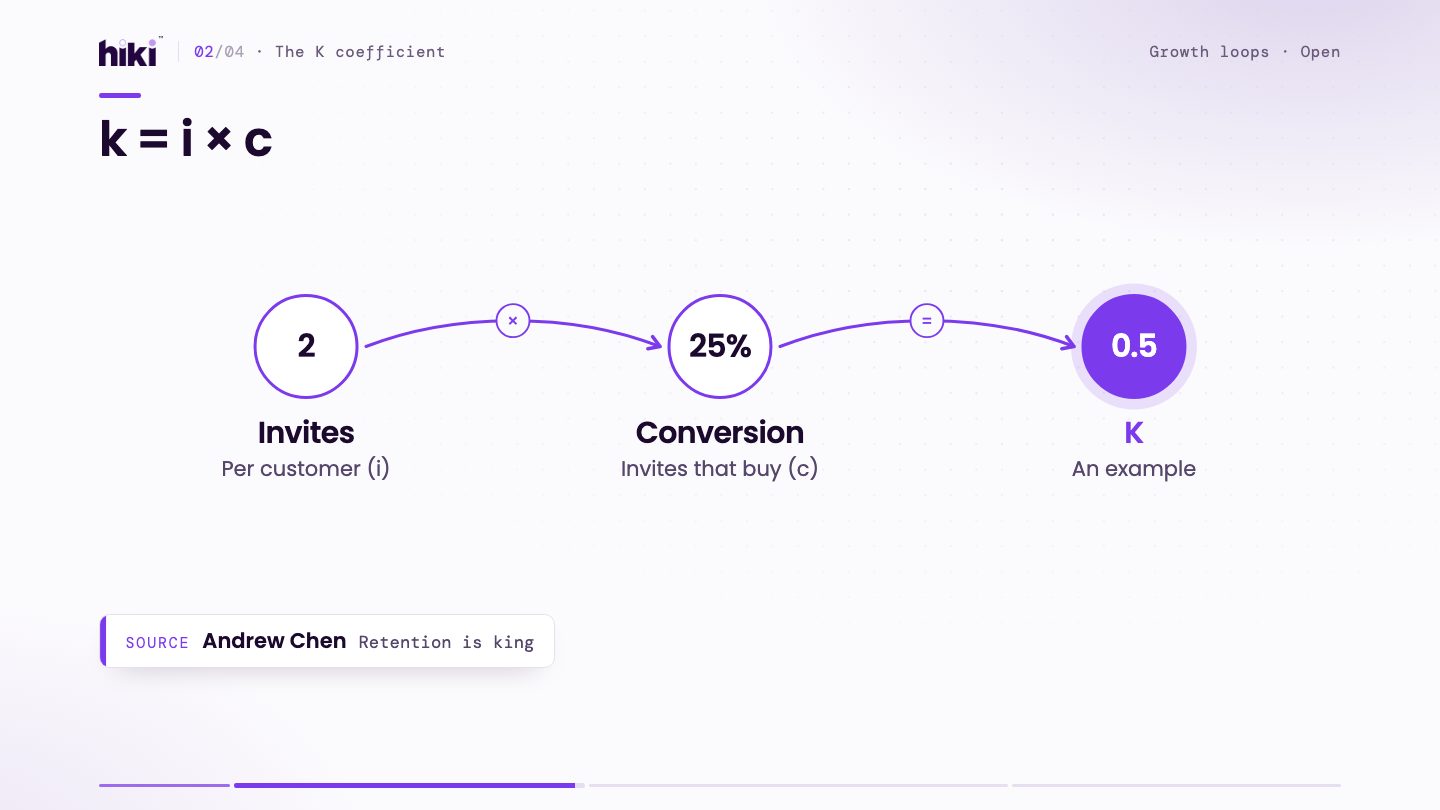
An excerpt from the concept's reading. You study the rest with your tutor, applied to your business.
What you learn
- The K coefficient
- Cycle time
- Payback
- The leverage point
- Retention first
It helps to have seen first
You study it in the course
Growth loops: grow your company faster
Sources
Every number in the concept comes from these sources. Examples and assumptions are labeled as such.
- Jim Collins, Turning the Flywheel (2019) y el concepto del flywheelReference book
- Nubank (Brasil), prospecto F-1 de Nu Holdings (1-nov-2021)Official or regulatory filing
- Nubank (Brasil; opera también en México y Colombia), prospecto de salida a bolsa (424B1 / F-1, 9-dic-2021)Official or regulatory filing
- Nubank, informe anual 20-F de 2025 (presentado el 8-abr-2026)Official or regulatory filing
- Nubank, resultados del 2T-2026Official or regulatory filing
- Andrew Chen, Retention is kingIndustry source
- Bold (Colombia), programa de referidos de comercios (términos V.1.1.1, publicados el 13-nov-2025, vigentes desde el 28-nov-2025; el programa inició el 12-dic-2020)Industry source
- Brian Balfour, Casey Winters, Kevin Kwok y Andrew Chen, Growth Loops are the New Funnels (Reforge, 31-jul-2018)Industry source
- Brian Balfour, Channel Model Fit for User AcquisitionIndustry source
- David Skok, Lessons Learned: Viral Marketing (For Entrepreneurs)Industry source
- Duolingo, crecimiento por retención (Jorge Mazal, exdirector de producto, en Lenny's Newsletter)Industry source
- Paul Graham, Do Things that Don't Scale (julio de 2013)Industry source
- Platzi (Colombia), referidosIndustry source
- Quizlet, loop de contenido descompuesto en variables (Reforge)Industry source
- Uber, el lado difícil (Andrew Chen)Industry source