
The flywheel: the wheel that ties your loops together
The flywheel is the strategy that ties your loops into a wheel where each turn builds on the last. You learn to draw yours from facts about your business, to spot the doom loop, three ideas for getting started (the four fits, the cold start and infrequent purchases) and why it pays to run the loop by hand before you automate it.
What it solves
If you switch tactics every quarter and nothing adds up, this is where you pick one direction and see which part of your business pushes the next.
To get started
In Turning the Flywheel (2019), Jim Collins describes a heavy wheel: the first push barely moves it, but each turn builds on the last and momentum accumulates. A flywheel has four to six components, and each is an almost inevitable consequence of the one before.
The flywheel is the strategy. Loops are the measurable mechanisms that turn one or more of its components.
The opposite of a flywheel is what Collins calls the doom loop: push in one direction, stop, change course, push in another. Ads this month, a sales team the next, influencers the month after. Nothing builds.
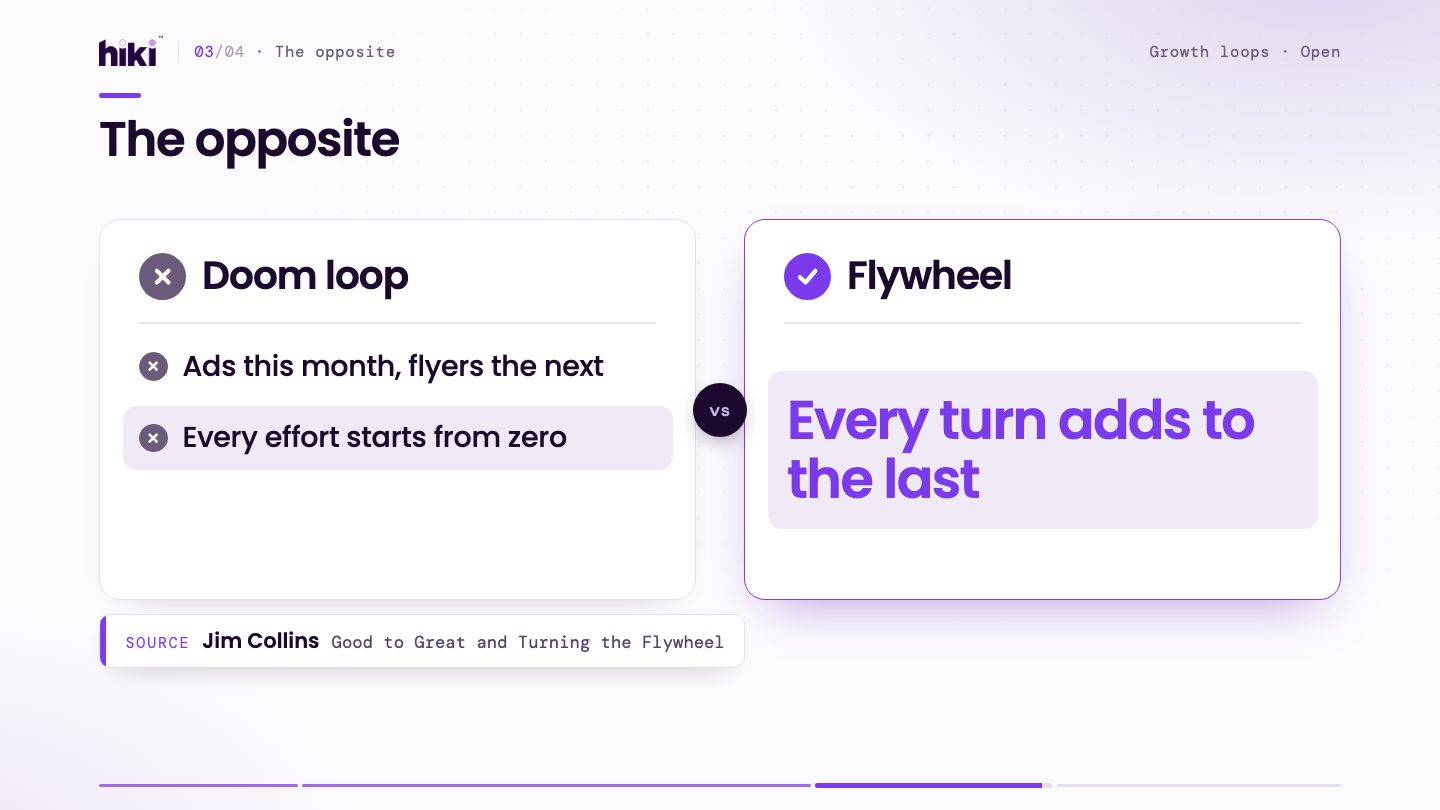
An excerpt from the concept's reading. You study the rest with your tutor, applied to your business.
What you learn
- The flywheel: the wheel that ties loops together
- Three more ideas you'll use
- Four common mistakes
It helps to have seen first
You study it in the course
Growth loops: grow your company faster
Sources
Every number in the concept comes from these sources. Examples and assumptions are labeled as such.
- Andrew Chen, The Cold Start Problem (Harper Business, 2021)Reference book
- Jim Collins, Turning the Flywheel (2019) y el concepto del flywheelReference book
- Mercado Libre, flywheel de comercio y pagos (carta a accionistas del 2T-2026, anexo 99.1 del 8-K del 5-ago-2026)Official or regulatory filing
- Nubank (Brasil), prospecto F-1 de Nu Holdings (1-nov-2021)Official or regulatory filing
- Nubank (Brasil; opera también en México y Colombia), prospecto de salida a bolsa (424B1 / F-1, 9-dic-2021)Official or regulatory filing
- Nubank, informe anual 20-F de 2025 (presentado el 8-abr-2026)Official or regulatory filing
- Nubank, resultados del 2T-2026Official or regulatory filing
- Andrew Chen, “The Atomic Network” (extracto de The Cold Start Problem en Lenny's Newsletter, 9-dic-2021)Industry source
- Brian Balfour, Channel Model Fit (ejemplo de LinkedIn)Industry source
- Brian Balfour, The Racecar Growth FrameworkIndustry source
- Duolingo, crecimiento por retención (Jorge Mazal, exdirector de producto, en Lenny's Newsletter)Industry source
- Paul Graham, Do Things that Don't Scale (julio de 2013)Industry source
- Platzi (Colombia), referidosIndustry source
- Rappi (Colombia), caso de BranchIndustry source
- Rappi, el arranque (entrevista de Y Combinator a sus cofundadores, 17-oct-2018)Industry source
- Reforge, ICED (Vivek Kumar)Industry source